
Pivot > Group Managing Director Bayard Hollingsworth on Lessons From the Front Lines of Turnarounds
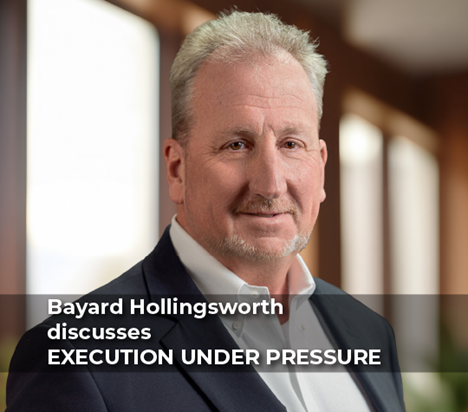
Bayard has spent his career working alongside companies during their most critical moments—when cash is tight, stakeholders are under pressure, and every decision results in real consequences.
He has sat in boardrooms, led and advised companies, participated in difficult negotiations, and designed and implemented operational and financial turnarounds. Those experiences have shaped a practical perspective: in high-pressure situations, leadership, a focus on details, sound judgment, and clear thinking are often what determines the outcome.
Below, Bayard reflects on several experiences that shaped his approach to turnaround leadership.
Q: Is there a turnaround outcome that still stands out to you because of the impact it had?
BH: One situation stands out because the outcome was both exemplary and inspiring.
The company was a national distributor of specialized activity-focused interior environments with revenue nearing $200 million. The company grew organically and through acquisitions and had recently partnered with a consulting firm to bundle these “hard goods” environments with performance-enhancing advisory services. The idea had real merit – don’t just sell hard goods but deploy them effectively with training and purpose to optimize the experience.
In practice, the two groups clashed. The consultants — highly educated and confident in their perspective — quickly tried to position themselves as “in charge,” while the distribution team strongly resisted. Leadership had rolled out a nationwide integration process without fully appreciating the challenge of mashing together two very different mindsets. Sales leveled off, inventory ballooned, liquidity tightened, and the situation drifted toward open rebellion.
As Turnaround Advisor, I concluded the company had effectively “bet the ranch” on an unproven model. I recommended immediately “stopping the violence” of the integration and shifting to a focused pilot approach in a limited number of markets – the ones most likely to be receptive.
The pilot projects worked. The value of the bundled offering became clearer to everyone, and internal skepticism gave way to demand. Area managers wanted in — not by mandate, but because they could more clearly see the opportunity. With proof established, the model was expanded thoughtfully throughout the country. The company recovered, and the owners ultimately successfully exited.
Situations like this are among the most rewarding in turnaround work—when unbiased perception, thoughtful plan design, careful implementation, and aligned incentives transform an existential challenge into a successful outcome.
Q: Can you share a turnaround case that genuinely surprised you?
BH: As CFO at a vertically integrated manufacturer, I was responsible for preparing a presentation and coaching our team of presenters to support our case to the lenders that we were the right partner to continue managing a highly distressed plastics producer, rather than our joint venture partner. I developed the pitch, created the materials, and prepared our team thoroughly, much like one would for a deposition or time on the witness stand. In the lead-up to the meeting, some contacts suggested the outcome might favor the other party, indicating they were likely to assume control of the operation. It felt like “goodbye”.
After delivering our presentation at a large New York law office, we were asked to step outside while the decision was made. About thirty minutes later, we were invited back in and learned that our presentation had shifted the decision in our favor, earning us the opportunity to manage the company through its turnaround. Our team’s organization, preparation, and composed handling of rigorous questioning proved decisive. In contrast, the other group – assuming success – appeared less prepared, which ultimately worked to our advantage.
The experience was certainly challenging, but I was both surprised and thrilled by the outcome.
Q: What’s the toughest call you’ve had to make during a turnaround, and how did stakeholders react at the time?
BH: I once found myself in the difficult position of recommending that a divisional leader – a close associate of the CEO – should step aside. The management team and shareholders were deeply divided—some strongly supported him while others felt the business needed a change. There was no clear path.
At the same time, this particular division was burning cash, and the business unit couldn’t continue in the same direction. Ultimately, a leadership change was made, and the turnaround moved forward through steps including reducing redundant inventory, right sizing the workforce, and rationalizing facilities.
While making the recommendation was fraught, the story didn’t end there. That individual later went on to start a company from scratch in a related sector and eventually sold it for an attractive price. He’s been very successful. Careers and businesses rarely move in straight lines, but things often work out positively in ways you don’t expect.
Q: What’s a common turnaround myth you’d like to bust?
BH: ‘There are no revenue-driven turnarounds.’
It’s rare, but it happens. One client distributed plumbing goods through big-box retailers – a painful, fraught business model. Instead of continuing down that path, the company shifted its strategy. It exited big-box distribution, sold the inventory for cash, and promoted a new product that helped customers address a significant residential and commercial plumbing challenge. The new product was a hit with customers and revenue took off.
The company began selling through local plumbing suppliers, achieved stronger margins, and expanded into commercial markets. The company recently became bankable again.
Q: What’s something turnaround experience teaches that textbooks don’t?
BH: Even when you know the truth—and it is factually the truth—the recipient of that truth may not thank you for it. This awareness teaches you how to communicate perceived truth with clarity, empathy, and credibility so it can be heard, understood, and ultimately acted upon.
Q: What advice do you give when a turnaround is considered?
BH: A turnaround is no place to address old grievances, exact revenge, or pick fights for the sake of fighting. The only thing that matters is objectively maximizing value. You cannot do that when decisions are driven by emotion. Set aside the past, stay flexible, and focus on rational decision-making. Everything else is far more expensive.